Softwash vs Pressure Wash — The Real Difference in Ireland
One removes what you can see. The other kills what's growing. Most Irish homes need both, on different surfaces.
People ring us asking for a power wash and describe a job that needs a softwash. It happens most weeks, and it isn't a daft mistake — the two look similar from the road. The difference is what each one actually does: a pressure wash uses force to strip dirt off a surface, and a softwash uses chemistry to kill the moss, algae and lichen that made the surface green in the first place.
That distinction decides whether a clean lasts months or years, and on some surfaces it decides whether the finish survives at all. Here's the honest comparison — what pressure each uses, which surfaces suit which, how long each lasts in the Irish climate, and the surfaces that should never see a pressure washer.
The short version
A pressure wash removes the visible dirt and growth by force. A softwash applies a biodegradable biocide at very low pressure and kills the organism, including the parts embedded in the surface. On a hard driveway you want both — the wash first, the softwash after. On render, roofs and soft stone you want softwash only.
| Pressure washing | Softwashing | |
|---|---|---|
| Pressure used | High — commonly 1,500 PSI and up | Very low — around 500 PSI or less |
| What does the work | Water force | The biocide, and the time it's left to dwell |
| What it removes | Visible dirt and the top of the growth | The whole organism, root and all |
| Suits | Tarmac, cobblelock, concrete, paths, yards | Roofs, render, painted walls, natural stone, timber |
| Must never be used on | K-Rend and silicone render, roof tiles, slate, pre-2000 fibre cement, aged pebbledash | Nothing — it's the gentle option |
| How long it lasts | Months. On a roof, roughly a year | Years, because regrowth has to start from new spores |
| Visible result | Immediate | Better within 24 hours, dramatically better in about two weeks |
| Risk to the surface | Real, and permanent on the wrong material | Minimal — no force involved |
If you only take one thing from the table: the "must never" row is the expensive one. A clean that doesn't last is an annoyance. Stripped render or broken slates is a bill.
Why Irish houses go green in the first place
Ireland has close to ideal conditions for moss, algae and lichen — mild, damp, rarely freezing hard enough or drying out long enough to knock the growth back. That's why a house here greens up within a few years of being built, and why the same house in a drier climate wouldn't.
Three different organisms are at work, and they don't behave the same way, which is the whole reason method matters:
- Algae arrives first. It's single-celled with no protective outer skin — the green dusting on a wall, or the black streaks running down south and west-facing tiles. Because there's nothing shielding it, a biocide kills it quickly.
- Moss establishes on top, anywhere the surface stays damp more than a few hours — north pitches, valleys, behind chimneys, the gutter line, the shaded side of the house. It anchors with fine rhizoids that work down into pores and cracks.
- Lichen comes last and is the hardest to shift. The yellow-orange rosettes are a fungus and an algae living together, and the fungus forms a tough outer skin that protects the algae inside. That's why heavy lichen often needs a second pass a few weeks later.
Now put a pressure washer to that. Force takes the top off the growth. The rhizoids stay in the pores, the lichen fragments stay in the surface, and blasting live growth actively spreads spores across the rest of the wall or driveway while you work. The surface looks clean and the biology is untouched — which is exactly why it comes back so fast.
When pressure washing is the right tool
Pressure has a genuine job to do, and we use it most weeks. On a hard, robust surface it's the fastest way to lift years of ingrained dirt, and it's the first stage of nearly all our driveway work.
- Cobblelock and block paving. The standard on Irish estate housing since the mid-1990s. A wide rotary surface head — 15 to 21 inches — spreads the pressure across a plate instead of driving it through a narrow lance. That's what prevents the striping you sometimes see after a DIY job.
- Plain concrete. A poured slab, path or yard is the most pressure-tolerant surface on most properties.
- Tarmac, carefully. Tarmac takes a wash, but at the lowest setting of anything — much over 100 bar erodes the bitumen binder that holds it together, exposes the chip and starts the premature fretting you see on older estate drives.
- Paths, steps and hard-standing. Usually the greenest and most slippery part of a property, and a safety job as much as a cosmetic one.
The common thread is that these are all hard, structural surfaces where the dirt sits on top and the material underneath can take the force. That's the test.
When softwashing is the right tool
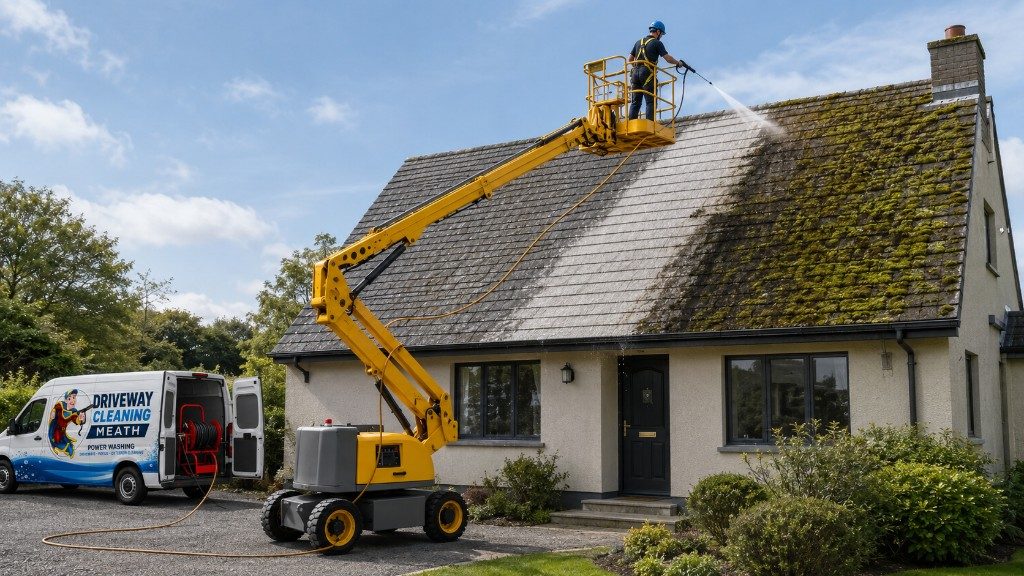
Softwashing is the safe choice on everything delicate, and it's the method we lead with on most jobs. Almost no pressure is involved — the biocide is applied, left to dwell, and the chemistry does the cleaning.
- Roofs — tile, slate and concrete. Our default, and for good reason: concrete tile has a cement-rich surface that pressure scours off, which speeds up the next moss growth rather than slowing it.
- Render — K-Rend, silicone, monocouche, painted render and pebbledash. All softwash, no exceptions.
- Painted and rendered walls, including the orange-red staining that's very common on north and east-facing Irish render. That staining isn't rust, despite what it looks like — it's an algae, and it needs a biocide, not a scrub.
- PVC fascia, soffits and downpipes. A gentle softwash brings back the original white without hand-scrubbing every metre.
- Natural stone and sandstone patios. Under 80 bar as a rule and never above 150 — sandstone pits under pressure, and a pitted slab holds dirt and re-soils faster from then on.
- Decking and timber fencing. Too much force tears the soft growth rings out and leaves the timber furred.
What all of these share is a surface where the finish itself is the thing you're trying to protect. Once it's stripped or pitted, no amount of cleaning brings it back.
When you want both — the combination that actually works
Most driveway jobs are both, in a fixed order, and this is the part that gets skipped.
Stage one — the low-pressure wash. A surface head lifts the dirt, the tyre marks and the grey film that builds up over a winter. This is the bit that gives you the immediate visual change.
Stage two — the softwash. A biodegradable biocide goes on at low pressure and is left to work. This is the bit that deals with why the driveway went green. It's also the bit that gets left out when a job is quoted purely on price.
The order matters. Washing first opens the surface up and takes off the bulk, so the biocide reaches what's left rather than sitting on a mat of dirt. Skip stage two and you've bought a few months. Do both and the growth has to start again from fresh airborne spores, which takes years rather than a season.
One thing worth knowing about the result: a softwashed surface doesn't look its best the same day. Algae bleaches out within hours to days, but moss and lichen turn brown and brittle and then detach gradually with wind and rain. It's better within 24 hours, dramatically better after about two weeks, and keeps improving with every shower.
Surfaces you should never pressure wash
This is the list worth reading before you book anyone, ours or otherwise. Each one of these costs real money to put right.
- K-Rend, silicone and monocouche render. These finishes are water-repellent by design. Pressure strips exactly the layer doing that work, and on most systems it voids the manufacturer's warranty outright. Modern Meath estates — Ashbourne, Ratoath, the newer Trim and Navan builds — are full of this render.
- Concrete roof tiles. The cement-rich surface comes off under pressure, leaving a rougher, more porous tile that greens up faster than before. Some manufacturers treat jet washing as voiding the guarantee.
- Natural slate. Brittle and lapped. Force breaks and dislodges slates, and drives water up under the laps into the roof space.
- Fibre cement slate fitted before 2000 (Tegrals). It may contain asbestos, and modern replacements look identical, so it should be treated as asbestos-containing until a survey proves otherwise. Never pressure-washed. Always ask the age of a roof first.
- Aged pebbledash and soft mortar. Common through the heritage cores of Trim, Kells and older Navan, much of it weathering since long before anyone owned a pressure washer. Force takes the stones off along with the dirt.
- Natural sandstone. Pitting is permanent.
- Pattern-imprinted concrete. The colour layer and sealer sit right at the top. Pressure removes both, and the driveway then needs resealing.
If someone offers to pressure wash your render or your roof, that tells you something on its own. It's a fair question to ask what pressure they'll use and what it does to the warranty.
What about my K-Rend, Tegrals or pebbledash?
These three come up constantly in Meath, so they're worth taking one at a time.
K-Rend and silicone render
Softwash only. The through-coloured, water-repellent finish is the product — strip it and you've damaged the wall, not cleaned it. Pressure washing voids the warranty on most systems, and manufacturers are explicit that a low-pressure, pH-appropriate biocide is the correct method. If your render is a few years old and gone green on the north side, that's normal for the Irish climate and it cleans up well.
Fibre cement slate (Tegrals)
Age is the first question, not the method. Fitted before 2000, it may contain asbestos, and because modern replacements are visually identical you can't tell by looking. Treat it as asbestos-containing until a survey says otherwise, don't pressure wash it, and get advice before anyone starts. Post-2000 fibre cement still shouldn't be pressure-washed — exposing the fibre matrix makes it weather quickly.
Pebbledash
Depends entirely on its age and condition. The original pebbledash on a 1960s or 70s house has been weathering for decades and the mortar bed behind the stones is soft; pressure takes the stones off. A gentle softwash lifts the green and black staining without driving into the surface. On newer, sounder dash there's a bit more latitude, but softwash is still the sensible default.
What each one costs — the part nobody explains
A softwash job usually prices higher than a plain pressure wash. There's chemistry involved, the application takes longer, and heavy lichen sometimes needs a second visit. Compared side by side on a single day, pressure washing is the cheaper line.
Compared over a few years it generally isn't, and that's the honest way to look at it. A power-washed roof is typically back to where it started in around a year. A correctly softwashed one holds for several. Pay for a wash every year or a softwash every few — that's the actual choice, and on a roof it isn't close.
There's a second cost that doesn't appear on any quote: the damage. Stripped K-Rend, a pitted sandstone patio or a fretted tarmac drive can't be cleaned back to right. They get repaired or replaced, and either bill dwarfs the difference between the two methods.
We don't publish prices, because a fair one depends on the surface, the size and how bad it's got. Brendan gives you a firm price on a quick house visit, free and with no obligation — and a few photos from your phone get you an answer faster.
How to tell which one you need
A rough rule that holds up well:
- Can you walk on it and is it hard? Driveway, path, yard, concrete — a wash is fine, and it wants a softwash after.
- Is it a wall, a roof, timber or soft stone? Softwash only.
- Is it green, black or orange rather than just dirty? That's living growth, so whatever else happens the job needs a biocide. Washing alone will disappoint you.
- Is it old, soft, painted or under warranty? Softwash, and ask the question before anyone starts.
And if you're not sure what your render or roof even is — plenty of people aren't — a photo answers it. Send a wide shot and a close-up of the worst section and we'll tell you which method it needs, whether or not you book anything.
Frequently asked questions
Is softwashing better than pressure washing?
How long does a softwash last compared to a pressure wash?
Does softwashing damage plants, pets or children?
Can I pressure wash my own render or roof?
Why does the growth come back faster after a pressure wash?
When is the best time of year to have it done in Ireland?
Related
Talk to us about softwashing or power washing
For further details and a no-obligation quote, please call Brendan on +353 87 824 1492 — or send a few photos from your phone.
Free, no-obligation quote — usually back to you within 24 hours. Local to Meath. Owner-operated. Fully insured.